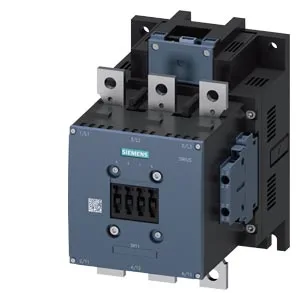
Envelope and Mounting
The 3RT1466-6XF46-0LA2: The contactor measures 202 mm deep by 145 mm wide by 210 mm high, which is the S10 footprint. It mounts via screw fixing — four 11 mm holes on a pattern that matches the standard S10 backplate. Those are the minimums for arc flash and heat dissipation, not suggestions.
Coil and Switching Characteristics
The coil is rated 110 VDC, with a dropout delay of 80 to 100 ms when the DC is removed. That's the time between losing the control signal and the main contacts actually opening — relevant if you're sequencing contactors in a safety circuit or a motor-reversing scheme.
Contact Ratings and Duty Cycles
The main contacts carry 156 A at 480 V and 144 A at 600 V — those are the AC-3 motor-switching ratings, which is what you care about for a motor starter. The auxiliary switch is included (yes, it's built in), with a range of DC switching capacities: 6 A at 24 V, 2 A at 48 V, 2 A at 60 V, 1 A at 110 V, 0.9 A at 125 V, 0.3 A at 220 V, 6 A at 230 V, 3 A at 400 V, 2 A at 500 V. That's a broad curve — the aux contacts can handle pilot duty, PLC inputs, or indicator lamps across common control voltages. The maximum mechanical life is 10 million operations, and the maximum switching frequency is 600 cycles per hour at AC-1 (resistive) and 350 at DC-1. For a motor-starting application, you'll likely be well under those numbers.
The power terminals accept solid or stranded wire: 2x (0.5 to 1.5 mm²), 2x (0.75 to 2.5 mm²), and max 2x (0.75 to 4 mm²). That covers standard control wiring up to about 12 AWG. The screw terminals are the standard cage-clamp style for the S10 frame — no special tools beyond a screwdriver and a torque wrench.