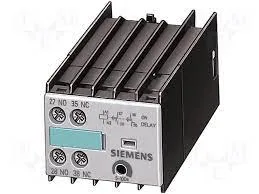
The Siemens 3RT1916-2GD51 is a SIRIUS-brand auxiliary switch with an adjustable ON-delay timer, designed to clip onto a contactor or star-delta starter assembly. It gives you a timed auxiliary contact that closes after a set delay from coil energization — the adjustable time range spans 1.5 to 30 seconds, with a recovery time of 150 ms before it can be re-triggered. The coil is rated for 200-240 V AC at both 50 and 60 Hz, so it drops straight into a standard European control-voltage circuit without a separate transformer tap. The switching contacts handle 1 A at 24 V, 0.2 A at 125 V, and 0.1 A at 250 V — enough for PLC inputs, pilot lights, or signal relays, not for direct motor switching. The part is explicitly designated for star-delta circuits, meaning the timer is wired into the transition leg between star and delta contactors. If your panel uses a star-delta start scheme, this auxiliary switch is the timed element that holds the star contactor closed for the acceleration period then releases it.
Clip-on mounting means it snaps directly onto the front of a SIRIUS contactor or onto a DIN rail adapter — no screws, no tools beyond a screwdriver for the wiring terminals. The IP20 finger-safe enclosure is standard for inside a panel; keep it behind a locked door or within a dead-front enclosure.
Ratings and environment
Storage and transport temperature range is -40 to +85 °C, and operating humidity is 15 to 95 % non-condensing. The mechanical endurance is listed as 10 000 000 typical cycles — that's the switch mechanism itself, not the electrical life under load. For the contact ratings given, expect the electrical life to be a fraction of that, especially at the higher voltage/current combinations.