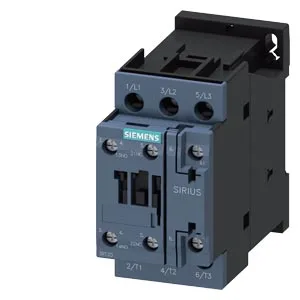
It carries a 14 A rated operational current at 480 V in AC-3 duty (cites:), which is the standard category for squirrel-cage motors — starting and stopping under load. At 230 V it's rated 3 hp (cites:), so it handles fractional-to-medium motor sizes in a compact 45 mm wide package (cites:). That's the standard rail profile in any EU or export panel, so it drops into existing layouts without adapter plates. Standing position on a horizontal surface is the specified orientation (cites:). Wire terminations accept solid or stranded conductors from 1 to 10 mm² (cites:, cites:), and the main contacts can take two conductors per terminal in the 0.5 to 2.5 mm² range (cites:). That covers most panel wiring from control circuits to motor feeds. Coil connections are screw-type terminals (cites:) — no push-in or spring-cage on this variant, so factor in screwdriver access during wiring.
Switching rates and mechanical life
Rated for up to 1,000 switching cycles per hour in AC-1, AC-2, AC-3, and AC-3e duty (cites:, cites:, cites:, cites:). That's typical for a general-purpose contactor in conveyor, pump, or fan cycling. For AC-4 duty — plugging or inching — the rate drops to 300 cycles per hour (cites:), reflecting the heavier arc wear from reversing or jogging under load. Mechanical life is quoted at 10 million operations typical (cites:), so it'll outlast most machines it's wired into.
DC switching capability
This contactor also handles DC loads, which matters for battery-backed or rectified circuits. Rated 10 A at 24 V DC, 2 A at 48 V and 60 V DC, 1 A at 110 V DC, and 0.3 A at 230 V DC (cites:, cites:, cites:, cites:, cites:). At 440 V DC it's rated 0.6 A (cites:). These are the DC-1 / DC-3 style values — resistive and lightly inductive loads. If you're switching DC motor fields or solenoid valves, these numbers govern the contactor's life, not the AC ratings.
Environmental limits and clearances
That's standard for a panel-mounted contactor — no special cooling needed in a ventilated enclosure, but keep it out of direct steam or oven exhaust. That's tighter than some older contactor families, so it packs into a smaller backpanel footprint without derating.