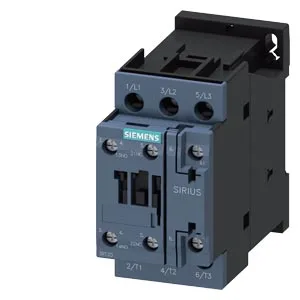
The DC coil pulls in reliably at 72 V nominal, with an operating time of 30 to 50 ms on DC and an arcing time of 10 ms — fast enough for most motor start/stop sequences but not for high-speed inverter bypass applications. Rated for AC-3 duty at 1 000 switching cycles per hour maximum, and 300 cycles per hour under AC-4 (plugging/reversing) duty.
The S0 footprint measures 45 mm wide, 91 mm tall, and 107 mm deep — a standard slot that fits alongside other S0 accessories (overload relays, terminal blocks) without crowding. The magnet coil connection uses ring cable lugs, so plan for ring terminals on the control wiring — not fork or pin terminals.
The built-in auxiliary switch is rated for DC switching at several voltage levels: 10 A at 24 V, 2 A at 48 V, 2 A at 60 V, 1 A at 110 V, 0.9 A at 125 V, 0.3 A at 220 V. For AC auxiliary loads: 3 A at 400 V, 0.6 A at 440 V, 14 A at 480 V, 2 A at 500 V. The 14 A at 480 V rating is unusually high — that's the AC-15 pilot-duty capability for the auxiliary contacts, meaning they can drive multiple contactor coils or indicator lamps in parallel without derating. The main contactor is rated for 3 hp at 230 V — that's the motor full-load current the contacts can make and break under AC-3 duty. For a 230 V three-phase motor, that covers up to about a 3 hp (2.2 kW) load. At 480 V the auxiliary contacts handle 14 A, but the main contactor's motor rating at 480 V is not listed in this data set — verify the full AC-3 current rating from the nameplate or datasheet before committing the BOM line.