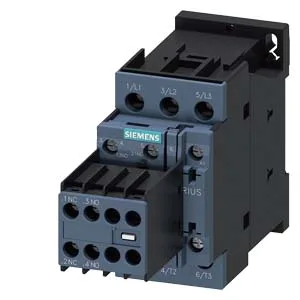
It mounts on a 35 mm DIN rail per DIN EN 60715, with either screw or snap-on fastening, and fits into the standard S0 panel footprint at 45 mm wide by 85 mm tall by 141 mm deep. At 230 V it carries a 5 hp motor rating, which is the figure a North American panel builder will check first for a pump or small conveyor. The switching frequency tells you how hard you can push it: 750 cycles per hour maximum in AC-3 (motor) duty, and 1 000 cycles per hour in AC-1 (resistive) duty. For heavy jogging or plugging (AC-4), the limit drops to 250 cycles per hour — that's the number that governs a reversing or inching application.
The 27 A at 480 V AC-3 rating is the headline number for motor switching, but the AC-1 resistive rating (not explicitly listed as a current value in the evidence) governs heater or lighting loads. The mechanical life of 10 million operations is typical for this class — the electrical life will be lower under full-load switching and depends on the duty cycle you run. Wire range is 1 to 10 mm² solid or stranded for the power circuit, with the coil terminals using screw-type connections accepting 2x (0.5 to 1.5 mm²) or 2x (0.75 to 2.5 mm²). No built-in auxiliary switch — if you need a mirror contact or a status feedback to the PLC, you'll add a side-mount auxiliary contact block. The S0 frame has a standard auxiliary slot that accepts the full SIRIUS range of add-on blocks.
Integration notes
That's the minimum air gap to adjacent metalwork or another contactor — factor it into your DIN-rail layout if you're stacking multiple units side by side. Arcing time is 4 to 16 ms at AC, with a typical value around 10 ms. That's relevant for coordination with upstream short-circuit protection — the let-through energy during arcing determines whether a fast semiconductor fuse or a standard motor circuit protector is the right choice. Coil operating frequency is 50 Hz at 0.25 A (likely the holding current). The coil terminals are screw-type, so no special tooling needed for termination.