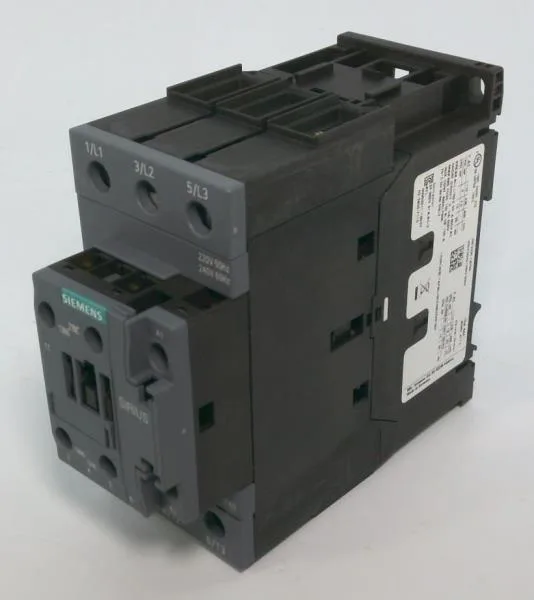
Its headline AC-3 rating of 40 A at 480 V means it handles a 20 hp motor at that voltage without derating — the rating that governs real motor duty, not the AC-1 resistive number. At 230 V it carries 7.5 hp, which is the common single-phase or small three-phase motor range for pump and conveyor applications. The contactor mounts via screw fixing or snap-on onto 35 mm DIN rail per DIN EN 60715, and the mounting position is flexible: ±180° rotation on a vertical surface, plus ±22.5° tilt forward/backward. That makes it straightforward to fit into existing panel layouts without reworking the backplate. It ships with an auxiliary switch block integrated (the 1AP60 variant), saving a DIN slot and the wiring of a separate aux block. The main contact configuration is 18 normally open contacts plus 1 normally closed — typical for a three-pole contactor with one N.C. auxiliary for feedback or interlock.
That's tight enough for dense panels — the side clearance is notably slim at 6 mm, so you can gang contactors side-by-side without excessive spacing. Main and coil terminals are screw-type, accepting solid or stranded wire: 2x (0.5 to 1.5 mm²) or 2x (0.75 to 2.5 mm²). The coil terminals are also screw-type, consistent with the main terminals. Strip length and torque values follow standard Siemens SIRIUS practice for Size S2.
Operating conditions and switching rates
The contactor is rated for switching frequencies up to 1,200 cycles/hour in AC-1 resistive duty, 1,000 cycles/hour in AC-3 motor duty, and 300 cycles/hour in AC-4 (plugging/reversing) duty.