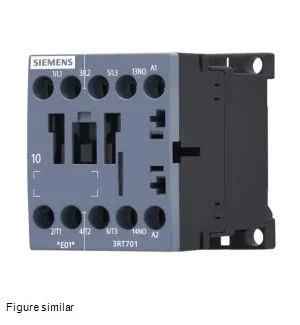
It carries 6 A at 230 V, 3 A at 400 V, and 1 A at 690 V — these are the operating currents that govern motor load selection, not a thermal continuous rating. The AC coil draws 0.8 W on closing and holds at 0.27 W DC, which keeps the control transformer load modest in a multi-contactor panel.
The 3RT7017-1AQ02 uses screw-type terminals for both the main current circuit and the auxiliary/control circuit. The main terminals accept 2x (0.5 to 1.5 mm²) solid or stranded, or 2x (0.75 to 2.5 mm²) — fine for the 6 A load but note the limited wire range if you are paralleling feeds. Side-by-side mounting is permitted, so no spacing gap is required between contactors on the rail, which saves panel width. The auxiliary switch extension is supported (product extension auxiliary switch: Yes), so you can add a side-mount block for status feedback without changing the contactor footprint. The contact reliability is specified as acceptable for PLC control at 17 V, 5 mA — meaning the auxiliary contacts can switch low-level signals directly into a digital input card without a separate interposing relay.
For type of coordination 2 (the stricter standard for motor starters), the required upstream fuse is a gL/gG NH 3NA rated 20 A. For type of coordination 1, the fuse can be 35 A. This matters when designing a motor branch circuit that must clear a fault without damaging the contactor — type 2 coordination keeps the contactor usable after a short circuit.