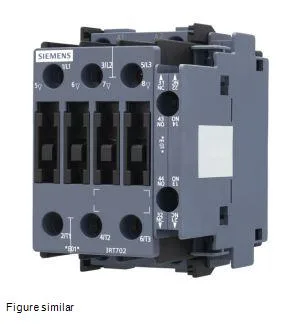
What It Is & Where It Goes
It's the core switching element for motor loads in a control panel — think conveyors, pumps, fans, compressors up to the S0 current range.
The AC-3 rated operational voltage goes up to 690 V, which covers standard 400 V three-phase motor circuits with headroom. The coil is 24 V AC — a common control voltage in industrial panels. Coil holding power is only 0.24 W DC, so the PLC or relay driving it sees a light load once the contactor is sealed. The auxiliary contact ratings are 6 A at 230 V, 3 A at 400 V, and 1 A at 690 V — enough for pilot lights, relays, or feeding back status to a controller. For DC switching, the DC-13 rating at 220 V is 0.3 A — that's your inductive DC load capability, like a DC brake coil or a small solenoid. If you're switching a DC load above that, you'll need a DC-rated contactor or a suppression network. Shock resistance is 12.5g at 5 ms and 7.8g at 10 ms — it'll hold in a vibrating machine tool or a compressor skid. Switching frequency: up to 800 operations per hour under AC-3 duty (motor starting), and 250 per hour under AC-4 (plugging/reversing). That's plenty for most process applications; if you're doing high-speed indexing, you'd need a larger frame or a dedicated DC-switching contactor. This matters when you're doing the selectivity study for the panel.
Integration Notes
The contactor accepts 2 x 0.5 to 1.5 mm² solid or stranded, or 2 x 0.75 to 2.5 mm² — fine for control wiring. An auxiliary switch block can be added on top (product extension auxiliary switch is supported), which is useful for adding a second NC or NO feedback contact without changing the base unit. Operating temperature range is -10 to +55 °C, storage -25 to +70 °C. That covers most indoor panel environments; if the panel is near a furnace or in a desert, you'll need to check the derating.