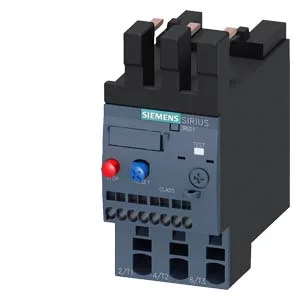
The Siemens 3RU2126-1GC0 is a SIRIUS thermal overload relay — a Class 10 device sized S0, rated for main circuits up to 690 V (AC-3e) and designed to protect motors against overload and phase loss. The integrated auxiliary switch provides a normally-closed and normally-open contact for the control circuit — the NC leg breaks the contactor coil on a trip, the NO leg signals the PLC. Spring-loaded terminals accept 2× (0.5 to 2.5 mm²) solid or stranded wire, so no ferrules are required for stranded conductors up to that size.
This relay mounts directly onto a SIRIUS contactor (contactor mounting) — no separate DIN-rail footprint. The S0 frame measures 45 mm wide, 102 mm high, and 84 mm deep, so it adds 84 mm of depth behind the panel door. The spring-loaded terminals face forward, making wiring accessible even with the relay snapped onto the contactor. Temperature compensation is active from -40 to +60 °C, so the trip point stays accurate across the operating range of the enclosure.
Auxiliary contact ratings — what the numbers mean
The integrated auxiliary switch is rated for several control voltages. At 24 V it switches 2 A; at 120 V it switches 3 A; at 230 V it switches 2 A; at 400 V it switches 1 A. These are the make/break ratings for the NC and NO contacts — the 3 A at 120 V is the highest current across the listed voltages, so it handles typical 120 VAC control circuits without derating. At 60 V the rating drops to 0.3 A, which is still adequate for low-voltage DC pilot circuits. Each pole dissipates 2.2 W, so the total heat load in the panel is the sum across all three poles — about 6.6 W when the relay is carrying current.