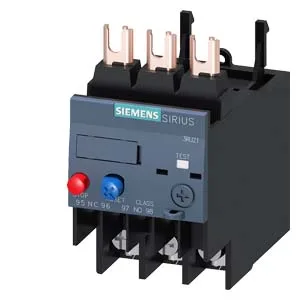
Rated for 690 V, this relay mounts directly onto a contactor (contactor mounting per), so it integrates into the motor starter stack without extra wiring or a separate enclosure. The auxiliary switch is integrated, saving a slot in the panel for a separate aux block.
The Trip Class 10 is the headline spec here — it defines how fast the relay opens on a locked-rotor event. For a motor driving a pump or conveyor, Class 10 gives enough time to ride through normal starting inrush without nuisance trips, but still protects the winding from overheating during a stall. If your application needs faster protection (like on a high-inertia fan), you'd step up to Class 5 or 10A, but Class 10 covers the vast majority of standard motor starts. The auxiliary contact ratings span the common control voltages you'll find in a panel: 2 A at 24 V, 3 A at 120 V, 2 A at 230 V, and 1 A at 400 V. At 690 V the aux contact is rated 0.75 A, so if you're switching a 690 V control circuit, keep the load under that. Power dissipation per pole is 2.2 W. In a densely packed panel with several overload relays side by side, that heat adds up — factor it into your enclosure ventilation calculation, especially if ambient hits 40 °C or higher.
Size S0 is the mid-frame in the SIRIUS overload relay family — it mates with S0 contactors like the 3RT102 or 3RT103 series. Mounting position is any, which helps when you're retrofitting into a cramped enclosure and can't guarantee vertical orientation. Main circuit connections use ring cable lugs with M4 screws. The screwdriver spec is Pozidriv PZ2 with a 5–6 mm shaft diameter — if your kit only has Phillips, grab a PZ2 bit before you start; Pozidriv cam-out is different and you'll strip the head with a Phillips driver.