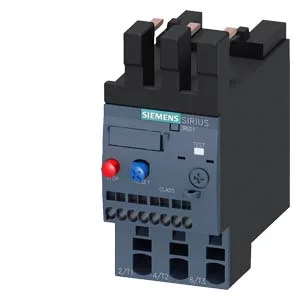
That Class 10 rating means it's matched to standard induction motors that don't need a long start delay; for high-inertia loads that take longer to spin up, you'd want a Class 20 or 30 relay instead.
The auxiliary contacts (integrated, normally closed for trip signalling) carry different currents depending on the control voltage: 2 A at 24 V DC, 3 A at 120 V AC, 2 A at 230 V AC, and 1 A at 400 V AC. That range covers most PLC input or relay coil circuits you'd find on a line. The spring-loaded terminals accept 2× 0.5 to 2.5 mm² solid or stranded wire, so no bootlace ferrules are strictly required — but I'd still use them for reliability on a vibrating conveyor.
Deployment context
The relay mounts directly to a contactor via the fastening method listed as "contactor mounting" — no DIN rail required. It can be installed in any position, which helps in tight enclosures.