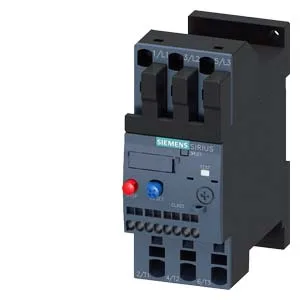
The Siemens SIRIUS 3RU2126-4DC1 is a thermal overload relay — the thing that sits between your contactor and the motor, watching for a locked rotor or a sustained overcurrent before the windings cook. That's fast enough to protect a standard squirrel-cage induction motor driving a conveyor, a pump, or a kiln fan, but not so fast that it nuisance-trips on a normal start. Rated insulation voltage is 690 V, and it carries motor ratings across common line voltages: 11 kW at 400 V, 15 kW at 500 V, 22 kW at 690 V. At 480 V and 600 V it's rated 25 A. That covers most 400 V class motors up to about 15 kW and 690 V class up to 22 kW.
Surviving the environment
This relay is built for the heat and the grit. That means the bimetallic strip inside still tracks the motor's true thermal state even when the panel is sitting next to a preheater tower or a clinker cooler. Mounts in any position, stand-alone installation. The S0 size — 45 mm wide, 114 mm tall, 95 mm deep — fits a standard DIN rail panel. Spring-loaded terminals accept 2× 0.5 to 2.5 mm² solid or stranded, so you're not fighting screw terminals when the panel is caked with dust. The auxiliary switch is integrated, no add-on block needed.
Auxiliary contact ratings — what they actually switch
The integrated auxiliary contact handles common control voltages: 2 A at 24 V, 3 A at 120 V, 2 A at 230 V, 1 A at 400 V. At 125 V DC it's 0.22 A, at 220 V DC it's 0.11 A.
MTTF under high demand rate is 2,280 years.