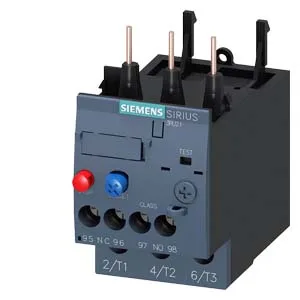
It's designed to bolt directly onto a matching contactor, saving DIN-rail space and keeping the motor branch circuit compact. At 480 V or 600 V it carries a full-load motor current of 32 A, which corresponds to 15 kW at 400 V and 18.5 kW at 500 V — a common range for small-to-medium fixed-speed pumps, fans, and compressors.
That's the standard for standard motors with normal starting times — a pump that spins up in a couple seconds is fine; a high-inertia fan that takes 15 seconds to accelerate will nuisance-trip on a Class 10. If you've got a long-start load, you'd need a Class 20 or 30 relay instead. The 32 A rating at 480 V and 600 V tells you the heater element is sized for that full-load current point. The relay accepts a range of current settings below that maximum, so you dial it to the motor nameplate FLA. The 15 kW / 18.5 kW / 30 kW power ratings at 400 V, 500 V, and 690 V respectively are the motor power the relay can protect at those line voltages — match the motor's rated voltage and power, not just the current. The auxiliary contact is integrated — no separate add-on block needed for the trip-indication or status feedback to the PLC. The Note 'for message Tripped' on the nameplate means the relay has a visual flag and a separate N/C contact that opens when the bimetals trip, so the control system sees the fault even if the contactor coil drops out.
It mounts directly onto the contactor via the Fastening Method 'Contactor mounting', so no DIN rail bracket is needed underneath; the whole assembly clips onto the rail as one unit. The main circuit connection uses ring cable lugs, with M4 screw terminals sized for a Pozidriv PZ2 bit. Temperature compensation is active from -40 to +60 °C, so the trip curve stays accurate in a hot panel or a cold enclosure. The 3.2 W dissipation per pole at full load adds up — three poles at 9.6 W total — so if you're packing multiple contactor/relay pairs in a sealed cabinet, factor that heat into the ventilation calc.