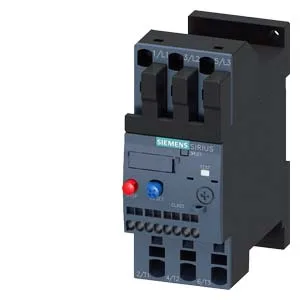
The Siemens 3RU2126-4PC1 is a SIRIUS S0 thermal overload relay — the part that sits between your contactor and the motor, watching for an overcurrent condition that would cook the windings. It's Class 10, meaning it trips fast enough to protect a standard squirrel-cage motor during a stalled-rotor start, but not so fast that it nuisance-trips on a normal acceleration curve. Rated to switch 18.5 kW at 400 V and handle a maximum of 690 V, so it covers the common European 400 V line and the 690 V industrial bus. The S0 frame size is the compact one — fits into a standard motor starter assembly without eating up DIN rail space.
If your motor has a long acceleration time (high-inertia loads like a centrifuge or a crusher drum), you'd step up to Class 20 — but for most line applications, Class 10 is the right call. It's a thermal bimetallic release — old-school, reliable, no electronics to fail in a hot panel. Spring-loaded terminals accept 2x 0.5 to 2.5 mm² solid or stranded. That's the standard control-wiring range; no need for ferrules if you're terminating stranded, though a ferrule makes for a cleaner connection in a vibrating panel. That means this relay can live in an unheated enclosure in a Canadian winter or a Middle Eastern substation shed without derating.
The auxiliary contact ratings cover the common control voltages: 2 A at 24 V, 2 A at 230 V, 1 A at 400 V, and 3 A at 120 V.
Mounts in any position — horizontal, vertical, upside-down, doesn't matter. Stand-alone installation means it clips directly onto the contactor or onto a DIN rail, no adapter plate needed. Dimensions are 45 mm wide, 114 mm tall, 95 mm deep — fits the S0 footprint. The "for message 'Tripped'" note on the relay means it has a mechanical flag or auxiliary contact that signals the tripped state — you don't have to guess whether it's the overload or the contactor that opened the circuit.