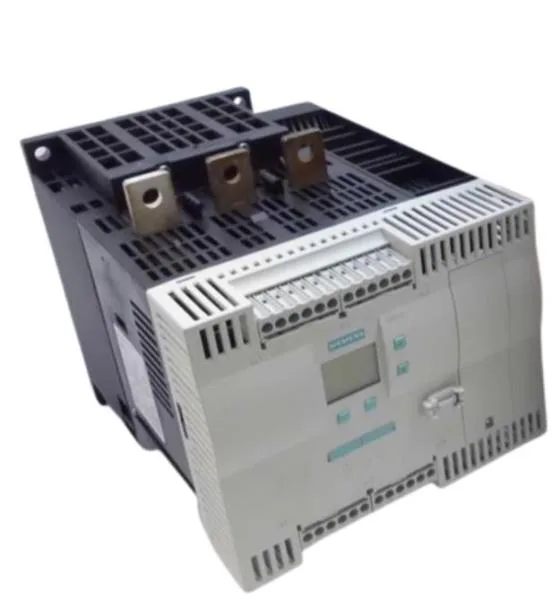
748 A at 40 °C — the derating curve decides your panel budget
The 3RW4447-6BC36: Above 40 °C the rating drops to 667 A at 50 °C and 580 A at 60 °C, so a hot panel or poor airflow eats capacity fast; plan the ventilation or derate the motor accordingly. Inside-delta wiring is supported, which reduces the line current the starter sees by roughly 42 % compared to standard in-line connection — useful for keeping cable sizes and contactor ratings lower on the line side.
Mounting and panel fit — screw-fixed footprint with clearance zones
It can be rotated ±90° or tilted ±22.5° front/back, giving flexibility in tight cabinets, but the derating curve assumes vertical orientation — tilting may reduce natural convection and require a further current reduction. Clearance zones: 100 mm above, 75 mm below, 5 mm at the sides. The 100 mm top clearance is the critical one — hot air rises off the heatsink, and choking that gap raises the internal temperature and triggers derating.
Wiring and termination — busbar and lug ranges for the main circuit
Main current circuit termination is busbar connection. Acceptable conductor sizes: stranded 70–240 mm², finely stranded 50–240 mm², and AWG/kcmil 2/0–500 kcmil using both clamping points. The front clamping point handles 3/0–600 kcmil; the back clamping point 250–500 kcmil. Maximum motor cable length is 500 m — sufficient for most distributed drive layouts, but long runs increase capacitive charging current and may require an output reactor if the cable exceeds the starter's internal dv/dt capability.