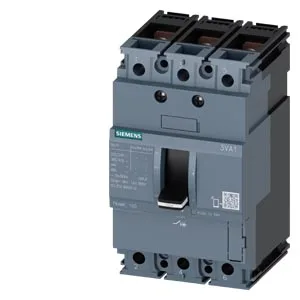
What this 3VA1020-4ED32-0DA0 brings to a panel
The Siemens SENTRON 3VA1020-4ED32-0DA0 is a 3-pole molded case circuit breaker rated for a continuous current of 20 A, fitted with a TM210 thermal-magnetic overcurrent release and a factory-integrated undervoltage release (UVR). It is the line protection variant, meaning it protects downstream cables and equipment against overload and short-circuit without integrated ground-fault or phase-failure detection. The TM210 release gives a fixed thermal pickup and magnetic trip that is non-interchangeable in the field — what you see is what you get for the 20 A frame. At 240 V it interrupts faults up to 121 kA, at 415 V up to 75.6 kA, and at 690 V still holds 11.9 kA, so it handles high available fault current in distribution panels without requiring a current-limiting upstream device in most installations.
Thermal derating and ambient temperature
The 20 A rating holds flat from 40 °C through 50 °C ambient. Above that it begins to taper: 19.2 A at 55 °C, 18.8 A at 60 °C, 18.4 A at 65 °C, and 18 A at 70 °C. If the breaker lives in a hot enclosure — say, next to a drive or transformer — expect to lose roughly 1 A per 10 °C above 50 °C. The operating range is -25 °C to +70 °C, storage from -40 °C to +80 °C.
Physical fit and mounting
The breaker measures 130 mm high, 76.2 mm wide, and 70 mm deep. That 76.2 mm width is a standard 3-pole MCCB footprint — three 25.4 mm pole pitches — so it drops into existing DIN-rail or screw-mounted panel layouts without re-drilling. IP40 on the front means it is protected against tools and wires greater than 1 mm, but the terminals are not sealed against dust ingress; keep it inside a closed panel.
Integrated undervoltage release
This order code ships with an undervoltage release (UVR) as the auxiliary release. That means the breaker trips automatically when control voltage drops below a threshold — common for emergency-stop chains or mains-monitoring circuits where you want the breaker open on loss of control power. The UVR is designed in, not added as a field-installed accessory, so the wiring plan should account for it from the start.
