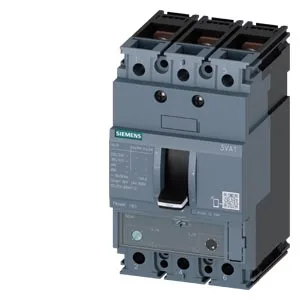
The Siemens SENTRON 3VA1150-3EF32-0KC0 is a 3-pole molded case circuit breaker (MCCB) rated for line protection, carrying 50 A continuously at 40 °C ambient and delivering a 75.6 kA interrupting capacity at 240 V — enough to handle high-fault utility feeds or transformer secondaries without cascading upstream. This is a current-production part in the SENTRON family, built for panel builders who need a compact, high-interrupt MCCB with integrated auxiliary switching and shunt trip capability.
The interrupting ratings are voltage-sensitive: 75.6 kA at 240 V, 52.5 kA at 415 V, 32 kA at 440 V, and 11.9 kA at 500 V and 690 V. At 690 V the 11.9 kA rating still covers most industrial motor branch circuits; if your available fault current at that voltage exceeds 11.9 kA, you need a current-limiting upstream device or a higher-rated frame.
The breaker holds 50 A from 40 °C through 50 °C ambient, then derates smoothly: 49 A at 55 °C, 48 A at 60 °C, 46 A at 65 °C, down to 45 A at 70 °C. Maximum power dissipation is 14.6 W, which is modest for a 50 A MCCB; adjacent devices in a crowded enclosure won't see significant additional heat load.
Auxiliary switching and shunt trip — what's inside
That means you get remote status indication (open/closed/tripped) on two independent contacts, plus a remote trip coil that can be triggered by a safety relay, PLC output, or emergency-stop button. No undervoltage release is fitted, and there is no ground-fault monitoring module — if you need UVR or GF protection, you add them as external accessories or pick a different suffix. The auxiliary release is wired separately from the main load circuit; the shunt trip coil voltage must match your control voltage — verify polarity and coil rating before commissioning.