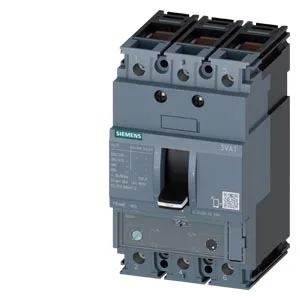
The Siemens SENTRON 3VA1150-3EF36-0CA0 is a 3-pole molded case circuit breaker (MCCB) rated 50 A at 40 °C, with a TM240 thermal-magnetic overcurrent release and an integrated undervoltage release. The interrupting ratings climb to 75.6 kA at 240 V, 52.5 kA at 415 V, and still hold 11.9 kA at 690 V, so it handles high-fault scenarios on 480Y/277 V or 400 V industrial services without cascading upstream.
The 75.6 kA at 240 V is the headline number, but the real-world decision point is the 52.5 kA at 415 V — that's the available fault current on a typical 400 V industrial service. If your transformer's impedance keeps the prospective short-circuit current under that, this breaker coordinates cleanly.
Above that, it drops to 49 A at 55 °C, 48 A at 60 °C, 46 A at 65 °C, and 45 A at 70 °C. If your panel runs hot (enclosed, solar combiner, near a furnace), size the continuous load to the 70 °C figure, not the nameplate.
The breaker measures 70 mm deep, 76.2 mm wide, and 130 mm tall — a standard 3-pole MCCB footprint that fits most DIN-rail or panel-mount enclosures without re-drilling.