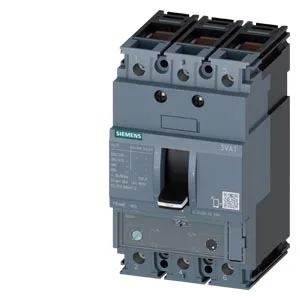
Its 50 A rated continuous current Iu holds flat from 40 °C through 50 °C, then derates to 45 A at 70 °C — so in a warm enclosure you lose 5 A off the top, not the full 10 % some breakers drop. The TM240 thermal-magnetic release handles the overload and short-circuit trip curve; the interrupting ratings hit 75.6 kA at 240 V and 52.5 kA at 415 V, which gives selectivity headroom against a 65 kA upstream transformer fault in a 480 V panel.
The 3VA1150-3EF36-0CH0 carries a 75.6 kA interrupting rating at 240 V and 52.5 kA at 415 V — that SCCR covers most industrial service-entrance and sub-feed applications without needing a current-limiting fuse upstream. The 15 000-cycle mechanical endurance is standard for a panel-mounted MCCB; it is not a switching device for frequent motor starts, but it will survive decades of infrequent operation. The undervoltage release (UVR) integrated as standard lets you drop the breaker on a safety circuit or E-stop chain — no separate shunt-trip module to buy and wire.
The 3VA1150-3EF36-0CH0 measures 130 mm high, 76.2 mm wide, and 70 mm deep — a standard MCCB footprint that fits most DIN-rail or panel-mount bases. The 3-pole design with line protection (no ground-fault or phase-failure module) keeps the wiring simple: line in, load out, and the UVR coil wired to the safety circuit. The trip indicator gives a visible flag on the front when the breaker has tripped on fault — saves chasing a phantom open.