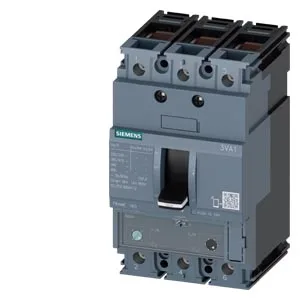
It carries a 50 A rating at 40 °C and a breaking capacity of 75.6 kA at 240 V, which means it can safely interrupt fault currents up to that level on a 240 V line without the arc flashing upstream. That's the number that decides whether this breaker coordinates with your existing switchgear or needs a higher-rated upstream device. Three poles, TM240 thermal-magnetic overcurrent release, and an undervoltage release (UVR) built in — so it drops out if the control voltage falls, which is a common requirement for motor feeder circuits where you want a guaranteed trip on loss of control power.
The interrupting rating drops as system voltage rises: 75.6 kA at 240 V, 52.5 kA at 415 V, 32 kA at 440 V, and 11.9 kA at both 500 V and 690 V. If your panel's available fault current at the breaker's line side is, say, 40 kA at 480 V, this breaker's 32 kA at 440 V is the relevant comparison — you'd need to check coordination at the actual system voltage, not the 240 V number.
Above that it derates: 49 A at 55 °C, 48 A at 60 °C, 46 A at 65 °C, and 45 A at 70 °C.
The undervoltage release is the only auxiliary release fitted.
Power loss
Maximum power loss is 17.1 W.