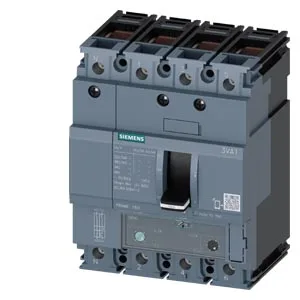
MCCB for line protection — 50 A, 4-pole, TM240 release
The Siemens SENTRON 3VA1150-3EF46-0AA0 is a 4-pole molded case circuit breaker (MCCB) rated 50 A at 40 °C, designed for line protection in distribution panels. Its TM240 thermal-magnetic overcurrent release handles overload and short-circuit protection without a separate trip unit — a fixed, non-interchangeable release that suits standard feeder and sub-feed applications where you don't need the flexibility of an electronic trip. Breaking capacity is 75.6 kA at 240 V, 52.5 kA at 415 V, and 32 kA at 440 V — figures that give solid SCCR headroom for most industrial and commercial panelboards fed from a transformer of typical impedance. At 690 V it still interrupts 11.9 kA, so it can serve 690 V line-to-line systems (common in mining or marine) as long as the available fault current stays under that ceiling. The 70 mm depth and 101.6 mm width (4-inch standard MCCB footprint) mean it fits existing 4-pole breaker slots in SENTRON and most third-party distribution boards without re-drilling the mounting plate. IP40 on the front is the usual indoor panel protection — no washdown rating, so keep it behind a gland plate or enclosure door.
Thermal derating and power loss
Current rating holds at 50 A from 40 °C up to 50 °C ambient, then derates linearly: 49 A at 55 °C, 48 A at 60 °C, 46 A at 65 °C, 45 A at 70 °C. If your panel internal ambient runs above 50 °C (tight enclosure, solar load, adjacent heat sources), size the upstream conductor and breaker for the derated value — the 45 A at 70 °C floor is the worst-case continuous current this breaker can carry without nuisance tripping. Maximum power loss is 14.6 W — modest for a 4-pole 50 A MCCB. In a densely packed panel, that's one less heat source to factor into the thermal budget; you can usually skip forced ventilation unless the enclosure is sealed and full of other dissipating devices.
What the ratings mean for your BOM line
The 75.6 kA at 240 V is the headline number for North American panels where the line-to-neutral fault current is the binding constraint; the 52.5 kA at 415 V covers European 400 V three-phase systems. If your available fault current at the breaker's location exceeds these, you need a current-limiting upstream device or a higher-rated frame — but for most secondary distribution boards behind a typical 500–1000 kVA transformer, these numbers are more than adequate. Rated insulation voltage is 800 V, so the breaker is electrically rated for 690 V systems without derating the internal clearances. The storage temperature range of -40 °C to 80 °C means it can sit in an unheated warehouse or container without damage — the operating range of -25 °C to 70 °C is the binding limit once installed.
