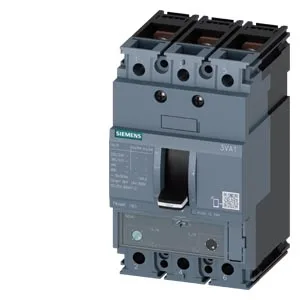
The Siemens SENTRON 3VA1150-4EF32-0DA0 is a 3-pole molded case circuit breaker (MCCB) rated for line protection, carrying 50 A continuously at 40 °C ambient without derating. Per the datasheet, the TM240 overcurrent release is a thermal-magnetic type, so it handles sustained overloads thermally and short-circuit faults magnetically — no electronic adjustment, no communication module. Breaking capacity is specified per IEC 60947-2 across multiple voltage levels: 121 kA at 240 V, 75.6 kA at 415 V, 52.5 kA at 440 V, and 11.9 kA at both 500 V and 690 V. That 121 kA figure at 240 V is high for a 50 A frame — it tells you this breaker can interrupt very high fault currents on the secondary side of a distribution transformer without welding contacts or rupturing the case. The 11.9 kA at 690 V is the limiting value for three-phase industrial supplies at that voltage.
Rated current holds at 50 A from 40 °C through 50 °C, then begins a gradual derating curve: 49 A at 55 °C, 48 A at 60 °C, 46 A at 65 °C, and 45 A at 70 °C. If your panel ambient runs above 50 °C, you lose roughly 1 A per 5 °C rise. The maximum power loss is 17.1 W, which is modest for a 50 A MCCB — that heat has to be dissipated into the enclosure, so factor it into your thermal budget if the panel is densely packed. Physical dimensions are 76.2 mm wide, 130 mm tall, and 70 mm deep. That 76.2 mm width is a standard 3-pole MCCB footprint — it fits a typical DIN-rail or panel-mount cutout without surprises.