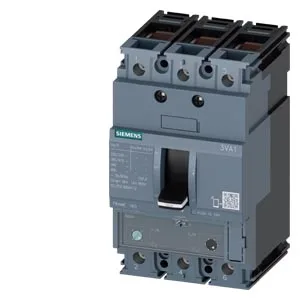
What you're looking at
It's a 3-pole unit rated for 50 A continuous at 40 °C ambient, and it holds that same 50 A rating all the way up to 50 °C before it starts to taper (49 A at 55 °C, 48 A at 60 °C, down to 45 A at 70 °C). That thermal stability matters out here in the grease: a hot panel next to a motor or a compressor won't force an early derate. The interrupting ratings tell the real story. This breaker clears 121 kA at 240 V, 75.6 kA at 415 V, 52.5 kA at 440 V, and still holds 11.9 kA at 500 V and 690 V. That's a lot of fault-current muscle for a 50 A frame — it means you can put this in a high-available-fault panel without worrying about the breaker failing to clear before upstream gear takes damage. No ground-fault monitoring on this version, and no communication module.
That's a standard 3-pole MCCB envelope — it'll drop into most SENTRON panelboards or DIN-rail adapter mounts without a fight. The 76.2 mm width (3 inches) is the same across the 3VA1 frame family, so if you're swapping out a different 3VA1 variant, the bus-bar spacing and lug positions will line up. Power loss at full rated current is 17.1 W maximum. That's moderate for a 50 A MCCB — plan for some heat rise inside the enclosure, but nothing that demands forced ventilation unless you're packing a dozen of these in a tight cabinet.
What it's built for
This is a line-protection breaker — Siemens designates it for protecting feeders and branch circuits, not motor-starting duty (no adjustable magnetic trip for inrush). The TM240 thermal-magnetic release gives you a fixed 240 A instantaneous trip, so it's sized for a 50 A continuous load with enough magnetic headroom to pass normal transformer inrush or capacitor bank charging current without nuisance tripping. The undervoltage release adds a layer of protection for applications where loss of control power should automatically disconnect the load — think conveyor systems, pump stations, or any process interlock where a dropout needs a hard trip, not just a contactor drop.