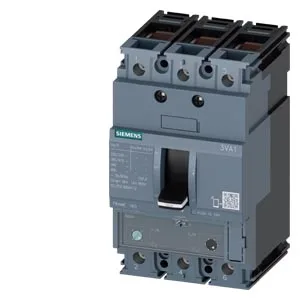
What this MCCB is and what it does
The Siemens 3VA1150-4EF36-0CC0 is a SENTRON molded case circuit breaker (MCCB) designed for line protection — the primary job is protecting cables and busbars from overloads and short circuits in distribution panels. It carries a continuous current rating of 50 A up to 55 °C ambient, then derates to 45 A at 70 °C (-). That thermal curve matters if you're packing this into a high-fill-factor enclosure where internal temps climb. Three-pole construction covers three-phase systems. The 800 V rated insulation voltage gives headroom for 480 V and 600 V class installations without creeping along the edge of the dielectric limit.
Breaking capacity — the real selectivity number
The interrupting rating is what decides whether this breaker clears a fault or welds shut. At 240 V it's rated 121 kA; at 415 V it's 75.6 kA; at 440 V it's 52.5 kA; at 500 V and 690 V it holds at 11.9 kA. For a 50 A frame, those numbers are high — this is a high-interrupting-capacity (HIC) variant meant for strong sources like transformer secondaries or generator bus ties where available fault current is substantial. If you're coordinating downstream, the 121 kA at 240 V means it can sit ahead of a panel with a 65 kA SCCR without an extra current-limiting fuse.
Auxiliary components and releases
This order code includes an undervoltage release (UVR) and two auxiliary switches HQ. The UVR trips the breaker when control voltage drops below a threshold — common in safety circuits where loss of control power must open the main disconnect. The two HQ auxiliary switches provide status feedback (open/closed/tripped) to a PLC or indicator lamp. The UVR is factory-fitted, not a field-add kit, so confirm your control voltage matches the release rating before panel wiring.
Physical fit and panel integration
Dimensions: 130 mm tall, 76.2 mm wide, 70 mm deep. That's a standard 3-pole SENTRON 3VA footprint — it occupies the same mounting pattern as other 3VA1 frame breakers. The 76.2 mm width (3 inches) is the panel cutout dimension to plan for. Maximum power loss is 17.1 W — negligible for thermal calculations in a ventilated enclosure, but worth noting if you're grouping several breakers in a sealed stainless box.
