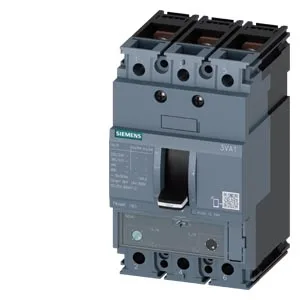
The Siemens 3VA1150-6EF32-0BH0 is a SENTRON molded case circuit breaker (MCCB) rated for line protection, carrying a continuous current Iu of 50 A across its three poles. The TM240 thermal-magnetic release handles overloads and short-circuits up to 220 kA at 240 V, 154 kA at 415 V, and 121 kA at 440 V — numbers that tell you this breaker is sized for high-fault panels where the available fault current is serious. At 690 V it still holds 17 kA, which covers most industrial motor-control center applications.
What the ratings mean for fit
The 50 A rating holds flat from 40 °C to 50 °C, then derates to 48 A at 55 °C, 47 A at 60 °C, 46 A at 65 °C, and 45 A at 70 °C. If your panel ambient runs above 50 °C, you need to account for that drop — the breaker doesn't lose its interrupting capacity, but the continuous current it can carry without nuisance tripping shrinks. The 800 V rated insulation voltage (Ui) means it's comfortable in 480 V and 600 V class systems with margin. This MCCB includes an undervoltage release (UVR) as the auxiliary release design, plus 2 auxiliary switches and 1 trip alarm switch (HQ version). The UVR drops the breaker if control voltage falls below a set threshold — useful for safety circuits where a loss of control power should open the main feeder. The trip alarm switch gives a separate signal when the breaker trips on fault, not just when manually opened. No communication function, no phase failure detection, no ground fault monitoring built in. This is a straight line-protection MCCB — you add external modules for those functions. The front carries IP40 protection, so it's fine for a clean indoor panel but not for washdown or dust-heavy environments.
Physical fit and integration
Dimensions: 130 mm height, 76.2 mm width, 70 mm depth. That width is a standard 3-pole MCCB footprint — it drops into a panel cutout or mounting plate designed for a 3-pole SENTRON 3VA frame. The 70 mm depth means it clears most 200 mm deep enclosures with room for wiring gutters. Latching endurance is rated at 15,000 operations, which is typical for a distribution breaker that sees infrequent switching — not a contactor replacement for frequent motor starting.
