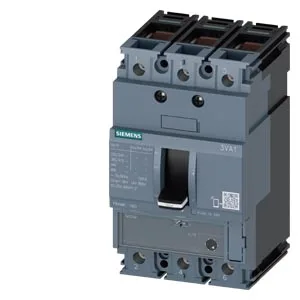
MCCB for motor and feeder protection — 50 A, 3-pole, TM120M release
The Siemens SENTRON 3VA1150-6MH36-0AA0 is a 3-pole molded case circuit breaker (MCCB) rated 50 A continuous, designed for starter protection in motor branch circuits and feeder applications. It carries a TM120M thermal-magnetic overcurrent release — the thermal element handles overloads, the magnetic element clears short-circuits — and is built into the 3VA platform that replaced the older 3VL series. Breaking capacity is the headline here: 220 kA at 240 V AC, 154 kA at 415 V, 121 kA at 440 V, and still 7.5 kA at 500 V and 690 V. That 220 kA figure at 240 V means this breaker can interrupt a fault current up to 220,000 A without welding its contacts or rupturing the case — essential for high-capacity transformer secondaries or large motor control centers where available fault current is extreme. Rated insulation voltage is 800 V, so the breaker is suitable for 480/277 V and 600 V systems with margin. The front face carries IP40 protection — tools and fingers stay out, but it is not sealed against hose-down; mount inside a panel enclosure rated for the environment.
Thermal derating — what 50 A means at panel ambient
The 50 A rating holds from 40 °C through 50 °C ambient. At 55 °C it derates to 49 A, at 60 °C to 48 A, at 65 °C to 46 A, and at 70 °C to 45 A. For a panel that runs warm — say 55 °C inside the enclosure — the breaker is good for 49 A continuous, not the full 50 A. If your motor FLA is 48 A and the panel ambient hits 65 °C, this breaker is marginal; step up to the next frame or improve ventilation. Maximum power loss at rated current is 14.6 W. That is the heat the breaker dumps into the enclosure; factor it into your thermal budget if you are packing several breakers in a small cabinet.
Dimensions and panel fit
The breaker measures 130 mm tall, 76.2 mm wide, and 70 mm deep. The 76.2 mm width (3 in) is the standard 3-pole MCCB footprint for this frame size — it occupies three 25.4 mm module positions on a DIN rail or mounts directly to a backplate via the screw terminals. The 70 mm depth leaves clearance for wiring gutters in a typical 200 mm deep enclosure.
