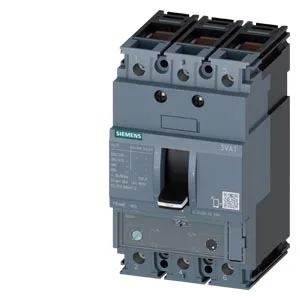
The Siemens SENTRON 3VA1163-3EF36-0AG0 is a 3-pole molded case circuit breaker (MCCB) rated 63 A at 40 °C, designed for line protection. It carries a TM240 thermal-magnetic trip unit — the thermal element handles overloads, the magnetic element clears short circuits fast. This is the kind of breaker you spec into a distribution panel feeding motor control centers or general power loads, where you need a reliable overcurrent trip without communication or ground-fault monitoring built in.
Breaking capacity and what it means on your line
This breaker's interrupting rating climbs with system voltage: 75.6 kA at 240 V, 52.5 kA at 415 V, 32 kA at 440 V, and 11.9 kA at both 500 V and 690 V. That 75.6 kA at 240 V tells you it can handle a serious fault downstream without welding its contacts — useful on a 240 V distribution bus where transformer inrush or a bolted fault could dump heavy current. The 11.9 kA at 690 V still covers most industrial motor circuits; just make sure your available fault current at the panel doesn't exceed that figure. The rated insulation voltage is 800 V, so the internal clearance is built for 690 V systems with margin.
Thermal derating and panel fit
At 40 °C, 45 °C, and 50 °C ambient the breaker holds a full 63 A. At 55 °C it drops to 62 A, at 60 °C to 61 A, at 65 °C to 60 A, and at 70 °C to 58 A. If your panel runs hot — say, packed with drives or transformers — that derating curve matters when sizing the feeder. The maximum power loss is 17.3 W, which is modest for a 63 A MCCB but worth factoring into your enclosure's thermal budget. Dimensions are 130 mm high, 76.2 mm wide, 70 mm deep — a standard 3-pole MCCB footprint that fits most DIN-rail or panel-mount arrangements. Operating temperature range is -25 °C to 70 °C; storage from -40 °C to 80 °C.
Auxiliary switching and trip indication
This variant comes with one auxiliary switch and one trip alarm switch (HP type). The trip alarm switch changes state only when the breaker trips on fault — not on manual open — so you can wire it into a PLC or alarm panel to flag a downstream short or overload. A trip indicator is present on the front face, giving a visual confirmation without needing to read the aux contacts. No undervoltage release, no communication module, no ground-fault monitoring on this order code — it's a straight thermal-magnetic line-protection breaker.
