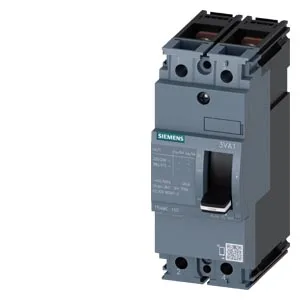
What this MCCB is and where it fits
The Siemens SENTRON 3VA1163-5ED22-0AA0 is a 2-pole molded case circuit breaker (MCCB) rated for 63 A continuous at 40 °C, with a TM210 thermal-magnetic overcurrent release. It is designed for line protection in distribution panels, meaning it guards the feeder cable and downstream loads against overloads and short circuits. The interrupting capacity sits at 187 kA at 240 V AC and 121 kA at 415 V AC — figures that cover high-fault utility feeds and industrial plant distribution. That kind of short-circuit rating means this breaker can clear a bolted fault without welding its contacts or venting arc gas into the enclosure, which matters when you are coordinating selective tripping upstream of a motor control center. The 70 mm depth and 50.8 mm width (2.76 in × 2 in) keep it compact enough for a multi-breaker panelboard. IP40 on the front face means it is sealed against solid objects over 1 mm — fine for a dry indoor panel, but not for washdown zones. If this is headed into a food plant or outdoor bucket, you will want an IP65-rated enclosure around it.
Thermal derating and real-world loading
The 63 A rating holds steady from 40 °C up to 50 °C. Above that, the thermal element starts backing off: 62 A at 55 °C, 61 A at 60 °C, 60 A at 65 °C, 58 A at 70 °C. If this breaker lives in a hot panel next to a drive or a transformer, size your continuous load against the 70 °C figure of 58 A, not the nameplate 63 A. The operating range is -25 °C to 70 °C, with storage down to -40 °C. Power loss maxes at 11.54 W per pole — negligible for a single breaker, but add up a panel full of them and the heat load matters for enclosure sizing.
Lifecycle and sourcing reality
The TM210 release and 2-pole 63 A frame are common across the 3VA family, so if you are holding a panel design around a 3VA1110-5ED32-0AA0, the footprint and mounting are the same — the difference is in the trip curve and current rating. No rewiring needed for the same frame size.
