What it is and what it does
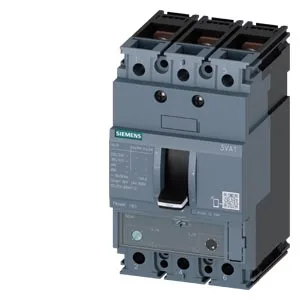
The Siemens SENTRON 3VA1196-4EF32-0DC0 is a 3-pole molded case circuit breaker (MCCB) rated for 16 A continuous current at 40 °C ambient, with a breaking capacity of 121 kA at 240 V AC. That 121 kA figure means it can safely interrupt a fault current up to that level without welding contacts or rupturing the case — critical for high-fault installations like transformer secondaries or large motor control centers where available fault current can exceed 100 kA. At 415 V the interrupting rating drops to 75.6 kA, and at 690 V it's still 11.9 kA, so it covers both 400 V and 690 V industrial distribution without needing an upstream current-limiting fuse. This MCCB is designed for line protection — meaning it sits at the feeder or sub-feeder level protecting cable and bus against overload and short circuit, not as a motor-protective device with integrated overload class. It carries an undervoltage release (UVR) and two high-quality auxiliary switches (form C), so it can drop the load on loss of control voltage and report its status back to a PLC or annunciator panel.
Ratings and what they mean for your panel
Rated insulation voltage is 800 V, so it's suitable for 690 V systems with margin. The 16 A rating holds steady from 40 °C up to 55 °C — no derating needed in a warm enclosure — then drops to 15 A at 60 °C and above. Maximum power loss is 13.1 W, which matters for thermal management in a sealed panel with multiple breakers ganged together. Dimensions are 130 mm high, 76.2 mm wide, 70 mm deep — a standard SENTRON 3VA frame size that fits the same DIN-rail or screw-mount footprint as other 3VA1 breakers. The 70 mm depth means it clears most shallow gland-plate enclosures, but always check the door-swing clearance if you're mounting it on a swing-panel.
Built-in auxiliaries and releases
Factory-fitted with an undervoltage release (UVR) and two auxiliary switches (HQ type). The UVR trips the breaker when control voltage drops below a threshold — standard for safety circuits where loss of power must open the main contacts. The two auxiliary switches provide independent NO/NC contacts for status feedback; no need to order separate accessory packs for basic signaling. No communication module, no ground-fault monitoring, no trip indicator — this is a functional, no-frills MCCB for straightforward distribution. If you need remote trip indication or ground-fault protection, you'd step up to a different 3VA variant with those options.
