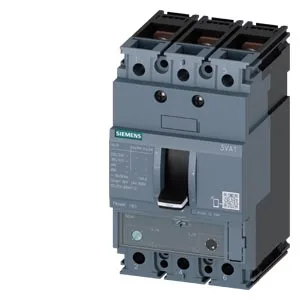
What it is and what the ratings mean for fit
The Siemens SENTRON 3VA1196-5EF32-0BA0 is a 3-pole molded case circuit breaker (MCCB) designed for line protection — it sits between the transformer and the distribution bus, not on a motor branch. Rated 16 A continuous at 40 °C ambient, it holds that rating through 55 °C and derates to 15 A at 60 °C and above, so if your panel runs hot near the top of the enclosure, you lose 1 A of headroom. The interrupting capacity tells the real story: 187 kA at 240 V AC, 121 kA at 415 V, 75.6 kA at 440 V, and still 17 kA at 690 V. That means it can clear a bolted fault on a 240 V secondary with massive available current — typical for large transformer-fed industrial panels — without the breaker itself failing open. The TM240 thermal-magnetic trip unit gives a fixed thermal curve and magnetic pickup; no electronic adjustment, no communication module, no ground-fault monitoring. It ships with an undervoltage release (UVR) integrated, so if your safety circuit drops the control voltage, the breaker trips — common in emergency-stop chains and machine isolation schemes.
Where it goes and how it mounts
This MCCB mounts on a DIN rail or can be screw-fixed to a backplate. At 70 mm deep, 76.2 mm wide, and 130 mm tall, it fits a standard 3-pole MCCB footprint — no surprises when you're laying out a panel that already holds SENTRON breakers. The 3-pole form factor means it switches all three phases simultaneously; the UVR coil draws from the line side, so no auxiliary power supply is needed for the trip function. Rated insulation voltage is 800 V, so it's comfortable on 480 V and 600 V class systems with margin.
