What the interrupting ratings mean for your fault-current study
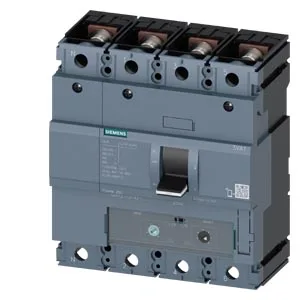
The Siemens SENTRON 3VA1225-5GF42-0AF0 is a 4-pole molded case circuit breaker rated for a continuous current Iu of 250 A, with a TM240 thermal-magnetic overcurrent release. Its interrupting capacity varies sharply with system voltage: 187 kA at 240 V AC, 121 kA at 415 V AC, 36 kA at 440 V AC, and 17 kA at 690 V AC. That 187 kA figure at 240 V means it can safely clear a fault on a high-capacity transformer secondary without the arc re-striking — critical for panel coordination studies where the upstream transformer is sized for a large industrial load. At 415 V, the 121 kA rating still covers most distribution boards fed by a 2 MVA-class transformer; the drop to 36 kA at 440 V reflects the physics of arc extinction at higher voltage, so verify your available fault current at the actual line voltage, not the nominal.
Thermal derating and panel fill factor
The breaker holds its full 250 A rating from 40 °C through 50 °C ambient. Above that, it derates linearly: 243.3 A at 55 °C, 236.5 A at 60 °C, 229 A at 65 °C, and 223 A at 70 °C. If the MCCB sits in a crowded enclosure with other heat sources, the 60 °C column is the realistic design point — 236.5 A continuous, not 250 A. The 70 mm depth and 140 mm width fit the standard SENTRON 3VA frame footprint, so it drops into existing panel cutouts without re-drilling the mounting plate. The front face carries IP40 protection, adequate for a clean indoor panel; no gasketing for washdown environments.
Auxiliary contacts and release options
Factory-fitted with one auxiliary switch and one trip alarm switch (HQ type) — that gives you a Form C for status indication and a separate Form C that changes state only on a trip event, useful for remote alarm annunciation. No undervoltage release, no shunt trip, no ground-fault module on this variant. The overcurrent release is the TM240 thermal-magnetic type, which means it uses a bimetal for overload protection and a solenoid for short-circuit response — no electronic adjustment, but also no auxiliary power draw and no nuisance tripping from harmonics. Latching endurance is rated at 15,000 operations, typical for a distribution breaker that sees infrequent switching.
