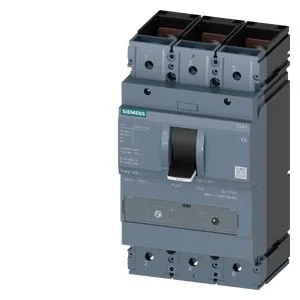
The Siemens SENTRON 3VA1332-6EF32-0AA0 is a 3-pole molded case circuit breaker (MCCB) rated for line protection, carrying 320 A continuously at 40 °C and holding that same rating through 50 °C — only then does it begin a gentle derating curve: 313 A at 55 °C, stepping down to 292 A at 70 °C. Breaking capacity is where this MCCB earns its keep for high-fault installations. At 240 V it interrupts 220 kA; at 415 V and 440 V it still holds 154 kA, dropping to 121 kA at 500 V and 17 kA at 690 V. It is a straightforward, field-reliable choice for a feeder or main where you do not need adjustable trip curves or remote signaling.
The breaker measures 248 mm high by 138 mm wide by 110 mm deep, which is the standard 3VA frame footprint; it drops into the same mounting pattern as other 3VA three-pole breakers in this frame class.
Integration notes
Power loss at full rated current is 80.1 W maximum, so factor that into your enclosure thermal calculation; a 320 A breaker dumping 80 W inside a sealed cabinet raises the internal temperature by several degrees and shifts the derating curve you saw above. If your circuit requires remote trip or status feedback, you will need to add the appropriate accessory module from the 3VA system — the basic breaker is a standalone thermal-magnetic device with no auxiliary contacts or trip indicator.