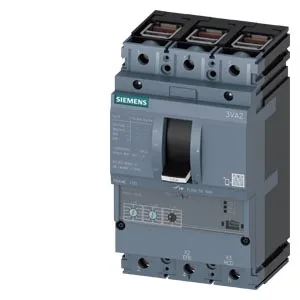
It's built for line protection — meaning it sits on the feeder side, guarding cables and downstream gear against overcurrent and short circuits. The electronic trip unit is an ETU320, which gives you adjustable long-time, short-time, and instantaneous pickup settings — handy for coordinating with downstream breakers so only the faulted branch opens, not the whole panel.
Interrupting capacity — the real story
This breaker's interrupting rating drops as system voltage climbs. At 240 V it's rated for 187 kA — plenty of headroom for most industrial services. At 500 V you're at 79 kA. If your transformer can push more than 3.4 kA at 690 V, this isn't the right breaker for that spot.
Above that it starts to taper: 60.6 A at 55 °C, 58.3 A at 60 °C, 55.9 A at 65 °C, and 53.6 A at 70 °C. Power loss is 5.4 W maximum, which adds to the enclosure heat load.
Auxiliaries and releases
The shunt trip (STL) allows remote tripping via a control signal, which is standard for emergency-stop circuits or remote shutdown. The integrated auxiliary trip module is order code 3VA9688-0BL33, and the supplied basic switch is 3VA2063-5HL36-0AA0.