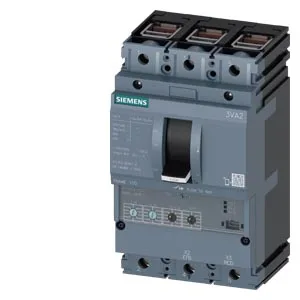
63 A MCCB with full-rated interrupting capacity across voltage bands
The Siemens SENTRON 3VA2063-5HN36-0BH0 is a 3-pole molded case circuit breaker rated for 63 A continuous current with no derating required across the full operating temperature range from -25 °C to 70 °C — the same 63 A holds at 40 °C, 55 °C, and 70 °C alike, so you size the feeder once and don't recalculate for panel ambient. Interrupting capacity is specified per voltage: 187 kA at 240 V, 121 kA at 415 V and 440 V, 75.6 kA at 500 V, and 3 kA at 690 V. That 187 kA figure at 240 V covers high-fault utility feeds; the 121 kA at 415 V matches typical industrial distribution in 400 V class systems. The drop to 3 kA at 690 V is expected for this frame size — the 63 A continuous rating governs the load side, not the fault rating at the highest voltage.
The 86 mm depth fits within typical 200 mm deep enclosures with clearance for rear-connected busbars. The basic switch assembly is order code 3VA20635HN360AA0 for replacement reference.
The part is specified into BOMs as a direct fit; no cross-reference or second-source substitution is required.