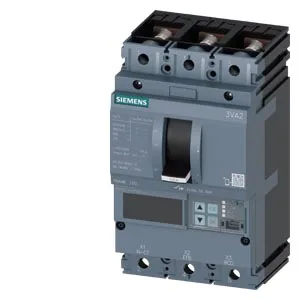
The Siemens SENTRON 3VA2063-5KP32-0KH0 is a 3-pole molded case circuit breaker rated for 63 A continuous current across the full ambient range from 40 °C to 70 °C. Designed for line protection, it carries a massive 187 kA interrupting capacity at 240 V, dropping to 121 kA at 415 V and 440 V, then 75.6 kA at 500 V, and 3 kA at 690 V. That's the kind of fault-current muscle that keeps a feeder or main panel coordinated when a bolted fault hits.
What the interrupting ratings mean on your panel
Built-in communication and auxiliary switching
This MCCB includes a communication function, so it can report status or trip events to a PLC or BMS — useful for remote monitoring without adding a separate I/O module. A shunt trip (STL) release is built in, allowing a remote emergency-stop or undervoltage signal to open the breaker. There is a voltage trigger and a mechanical trip indicator, so you can see at a glance whether it has tripped on a fault.
At 5.4 W maximum power loss, it won't drive much heat into the enclosure — you can pack other gear around it without worrying about derating the breaker itself.