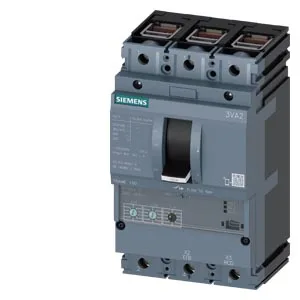
The Siemens SENTRON 3VA2116-5HL36-0BH0 is a 3-pole molded case circuit breaker rated for 160 A continuous current across the full ambient range from 40 °C to 70 °C — no derating needed up to that ceiling. That flat thermal curve is unusual; most MCCBs start rolling off above 40 °C. Here it holds 160 A all the way to 70 °C, which simplifies panel sizing in a hot cabinet next to drives or transformers. At 240 V it interrupts 187 kA; at 415 V and 440 V it holds 121 kA; at 500 V it drops to 75.6 kA; at 690 V it's 3.7 kA. No communication function onboard; this is a standalone line-protection breaker, not a metering or networked unit.
If you're swapping out an older 3VA1 or 3VF breaker, check the depth — 86 mm is shallower than some legacy frames, so the busbar stabs or rear-connection kit may need an adapter. Rated for line protection (cable and busbar feeder duty), not motor protection — no overload class or adjustable thermal curve for starting inrush. The trip indicator is present, so a visual flag shows after a fault event without opening the door.