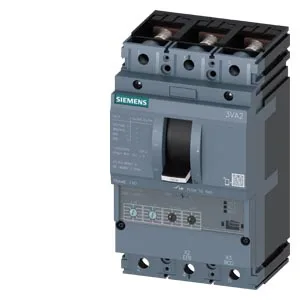
That 160 A holds flat from 40 °C through 50 °C — no derating needed in a warm panel — then steps down to 154 A at 55 °C, 148 A at 60 °C, 142 A at 65 °C, and 136 A at 70 °C. The interrupting capacity tells you where this breaker can clear a fault without welding or rupturing: 187 kA at 240 V, 121 kA at 415 V and 440 V, 79 kA at 500 V, and 4.25 kA at 690 V. Those are high-interrupt ratings for a 160 A frame — it handles stiff utility feeds and transformer-secondaries where fault current runs heavy. That means you can coordinate it downstream of a feeder breaker and upstream of branch devices without guessing at the thermal memory. It includes an undervoltage release (UVR) as the auxiliary release design, plus a 2+1+1 auxiliary contact configuration: 2 auxiliary switches, 1 trip alarm switch, and 1 electrical alarm switch. That's enough for remote status and a separate shunt-trip signal back to the PLC or safety relay. Maximum power loss is 28 W — worth accounting for in a densely packed enclosure with multiple breakers.
That covers unheated warehouses and outdoor cabinets in most climates. For a line-protection breaker that may only cycle a few times a year under fault, that's effectively unlimited.