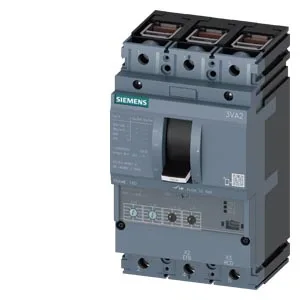
What the 160 A rating means for your panel
That 160 A holds steady even at 70 °C, which is unusual for breakers that typically lose capacity above 40 °C. The interrupting capacity hits 187 kA at 240 V AC, drops to 121 kA at 415 V and 440 V, then 75.6 kA at 500 V, and 3.7 kA at 690 V — so the 240 V figure is the headline, but the 415 V/440 V numbers are what matter for most European and Asian industrial feeders.
Physical fit and auxiliary switch configuration
Dimensions are 105 mm wide, 181 mm tall, 86 mm deep — standard 3-pole MCCB footprint for Siemens SENTRON 3VA2 frames. The breaker ships with two auxiliary switches (HQ design) pre-installed, so no separate order for aux contacts on a line-down swap. No trip indicator, no voltage trigger, no communication module.
Selectivity and coordination context
For selectivity studies: the 160 A frame with 121 kA at 415 V sits below larger SENTRON 3VA frames in a coordinated distribution scheme. The 800 V rated insulation voltage means it can be used on 690 V systems, but the interrupting capacity at 690 V drops to 3.7 kA — that's the weak point. If your fault current at 690 V exceeds that, you need a different breaker or upstream current-limiting device.