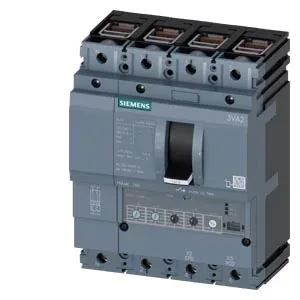
The Siemens SENTRON 3VA2116-5HN46-0HC0 is a 4-pole molded case circuit breaker rated for 160 A continuous current (Iu) at 40 °C, and it holds that same 160 A rating all the way up to 50 °C before it begins to step down — 154 A at 55 °C, 148 A at 60 °C, 142 A at 65 °C, and 136 A at 70 °C. The interrupting ratings are what earn this breaker its place on a distribution board: 187 kA at 240 V AC, 121 kA at 415 V AC, and 3.75 kA at 690 V AC. It ships with a built-in shunt trip (STL) as the auxiliary release, and the auxiliary contact block is configured as 2 auxiliary switches HQ. The trip indicator is absent, so you will not get a local mechanical flag showing the breaker tripped on fault; the auxiliary contacts are your only remote status feedback.
Panel fit and mounting constraints
The breaker occupies a 140 mm width, 181 mm height, and 107 mm depth footprint. That depth is the dimension that most often surprises a panel builder swapping from an older 3VA1 frame — the 3VA2116 is deeper by roughly 10 mm compared to the 3VA1010 frame, so verify the gland-plate clearance and the rear cable-entry space before you cut the mounting plate. Maximum power loss is 26 W at rated current. That is not trivial in a sealed enclosure — if you are stacking several of these on a DIN rail or a mounting plate, the cumulative heat load needs to be ventilated or the ambient temperature inside the enclosure will push the breaker into the derating curve above 50 °C.
Selectivity and coordination considerations
The ETU350 electronic trip unit provides LSIG protection curves (long-time, short-time, instantaneous, and ground-fault — though ground-fault monitoring is not fitted on this variant). The absence of a ground-fault module means this breaker will not detect or clear a ground fault on its own; if your system requires GF protection, you need the variant with the ground-fault monitoring option or an external ground-fault relay. The rated insulation voltage Ui is 800 V, so the breaker is suitable for 690 V systems with adequate clearance, but the interrupting rating at 690 V (3.75 kA) is the binding constraint — not the insulation voltage. That covers most indoor electrical rooms and outdoor enclosures in temperate climates, but if the breaker is installed in a location that sees sustained ambient temperatures below -25 °C (e.g., unheated Arctic-grade shelters), the ETU350 electronics may not power up reliably.