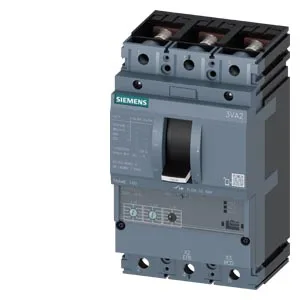
The interrupting capacity varies by system voltage — 242 kA at 240 V, 187 kA at 415 V and 440 V, 121 kA at 500 V, and 5 kA at 690 V — so selectivity studies need to reference the specific voltage on your distribution bus.
Ratings and thermal derating
Above that, derate linearly: 154 A at 55 °C, 148 A at 60 °C, 142 A at 65 °C, and 136 A at 70 °C. The maximum power loss is 25.5 W, which factors into the enclosure thermal budget.
The 86 mm depth includes the handle and terminal towers; verify clearance behind the panel door for the shunt trip wiring and auxiliary contact harness. The base breaker without the auxiliaries is order code 3VA2116-6HL32-0AA0; the integrated auxiliary trip module is 3VA9688-0BL32.
Auxiliary and alarm contacts
The HQ auxiliary contact block provides 2 form-C auxiliary switches, 1 trip-alarm switch (signals that the breaker tripped on a fault, not a manual open), and 1 electrical alarm switch. This is a signaling-heavy configuration suited for remote monitoring of the breaker state and fault events. If your application only needs a single auxiliary contact, a lower-configuration variant (e.g., 3VA2116-5HL32-0AK0) may be a closer fit — but that variant lacks the trip alarm and second auxiliary switch, so verify your PLC input count before substituting.