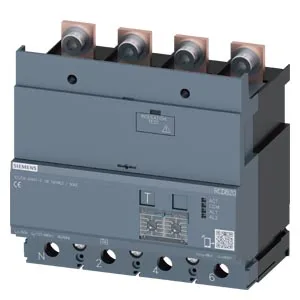
The Siemens 3VA9124-0RL30 is a SENTRON RCD820 advanced residual current device (RCD) — a Type A module designed for load-side mounting on 3VA2 molded-case circuit breakers. It provides adjustable ground-fault protection with a rated operational current of 160 A at AC and a selectable residual current range from 0.03 A up to 30 A. That wide trip range means you can dial in sensitivity from standard 30 mA personnel protection all the way to 30 A for equipment protection or selective coordination, all in one unit. This is a 4-pole device rated for system voltages of 100–690 V at 50/60 Hz, so it covers common low-voltage distribution panels in industrial and commercial builds. The main circuit connects via busbar connection, which keeps the wiring clean and reduces installation time in a panel — no ring-tongue terminals to torque.
The RCD820 mounts to the load side of a 3VA2 MCCB using screw fixing, and the infeed can enter from the top or bottom — useful when you're squeezing it into a tight distribution section and the busbars run the other way. Front protection is IP40, which is standard for panel-mounted gear; the enclosure keeps fingers out but it's not rated for washdown. That width is the same as a 4-pole 3VA2 breaker frame, so the assembly stacks without protruding.
Adjustability and monitoring features
The non-tripping time (tV) is adjustable from 0 to 10.0 s in steps, which lets you coordinate with downstream devices. The unit supports remote-controlled tripping and communication with residual current equipment, and you can select between RCD mode and pure monitoring mode — meaning it can report leakage without disconnecting the load, useful for condition monitoring or predictive maintenance setups. Both electrical and communication trip indicators are built in. The tripping characteristic is not selectable — it's fixed as Type A, which covers sinusoidal AC and pulsating DC residual currents. That's the standard for most commercial and industrial applications; if you need Type B (smooth DC) you're looking at a different module.