What the interrupting ratings mean for your fault-current study
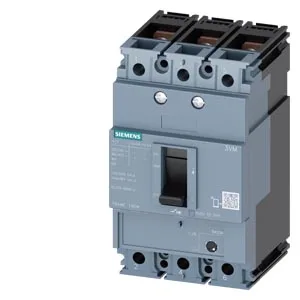
The Siemens SENTRON 3VM1110-5MH32-0AA0 is a 3-pole molded case circuit breaker (MCCB) rated for 100 A continuous at 40 °C through 50 °C, with a TM120M thermal-magnetic release. The interrupting capacity climbs to 187 kA at 240 V AC, drops to 121 kA at 415 V, 76 kA at 440 V, and 17 kA at 500 V. At 415 V, 121 kA still covers most industrial service-entrance applications in 400 V-class systems. The 17 kA at 500 V is a reminder that interrupting capacity falls off sharply as voltage climbs; if your system runs at 480 V or 500 V, check that the available fault current at the breaker terminals stays under 17 kA.
Thermal derating — don't oversize the panel ambient
At 55 °C it derates to 98 A, at 60 °C to 96 A, at 65 °C to 94 A, and at 70 °C to 91 A. That 4 A to 9 A drop matters when the load is already running near the trip threshold. The IP40 front protection means the breaker face is protected against solid objects over 1 mm, but the enclosure itself needs to manage the heat; the breaker's own maximum power loss is 23 W.