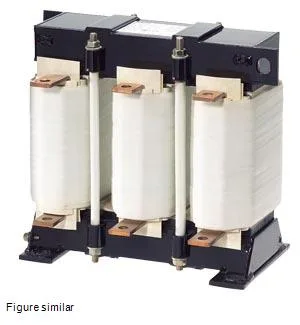
The Siemens SIDAC 4EU4531-0AD10-0B is a 3-phase output reactor (output choke) rated for 103 A continuous current on a 400 V AC system, with a switching frequency of 6.4 kHz and an inductance of 0.25 mH. It sits between a variable-frequency drive and the motor to limit the rate of voltage rise (dV/dt) and reduce capacitive coupling currents in long cable runs — a standard fit for motor drive applications where cable lengths exceed 50 m or where multiple motors share a single drive output. The 6.4 kHz figure is the switching frequency of the drive it's designed for — match this to the drive's PWM carrier frequency. The 18.7% impedance voltage (Uk) gives a rough measure of voltage drop at rated current, which matters for motor terminal voltage in long-cable installations.
Dimensions are 0.46 m wide by 0.43 m tall by 0.29 m deep. The main circuit connection uses flat-type terminals (flat connector), so plan for busbar or cable-lug terminations rather than spring-cage or screw-clamp blocks. Thermal class H (IEC 60085) means the winding insulation can handle a 180 °C hot-spot temperature, which is standard for reactor duty in high-ambient panels.
Losses and thermal management
Total power loss at rated load is 1310 W — 930 W in the coil and 380 W in the iron core. That's significant heat to vent; the panel must have forced-air circulation or sufficient natural-convection clearance around the reactor. At 40 °C ambient the reactor is at its rating limit; above that, derate current per the manufacturer's thermal curve (not provided here, but standard practice for class-H reactors).