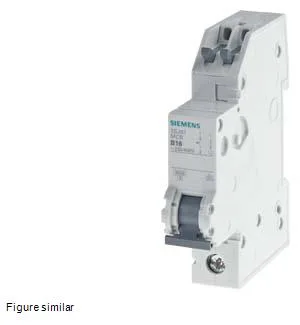
The Siemens SENTRON 5SJ6120-6KS is a 1-pole miniature circuit breaker with a B tripping characteristic, rated 20 A and a 6 kA breaking capacity per EN 60898 (also 6 kA per IEC 60947-2).
At 20 A, this MCB protects 2.5 mm² copper wiring in a 230 V single-phase or 400 V three-phase branch (used on one phase). The 6 kA breaking capacity at 230/400 V is sufficient for residential and light commercial service entrances where the prospective short-circuit current stays under 6 kA; for higher fault levels you step up to a 10 kA or 15 kA rated MCB in the same SENTRON family.
Screwless terminals and installation details
The outgoing terminals are screwless (push-in or cage-clamp style per the description), which speeds wiring on a panel assembly line — strip 8–10 mm, push the conductor in, no torque driver needed. The MCB is sealable, halogen-free and silicon-free, and rated IP20 with connected conductors. The 20 000 mechanical operating cycles typical reflects a service life well beyond what a residential or light-commercial breaker sees in practice.
Temperature range and environmental fit
That covers unheated utility rooms, outdoor enclosures in temperate climates, and warm panel interiors near other heat sources.
The closest peer in the SENTRON family is the 5SL6016-7: same 1-pole form factor, same 18 mm width and 76 mm depth, same 6 kA breaking capacity. The critical difference is the tripping curve — the 5SL6016-7 is a C-curve (5 to 10 times In), while the 5SJ6120-6KS is B-curve. For a panel originally wired around the 5SL6016-7, the 5SJ6120-6KS drops into the same DIN-rail slot and same busbar connection without rewiring, but the B curve trips faster on moderate overloads. If the load has a high inrush (small motors, fluorescent ballasts, switching power supplies), the C curve is the correct choice; for resistive or general-purpose circuits the B curve works and may provide better conductor protection. The 5SL6016-7 also has a 10 000 mechanical cycle rating versus 20 000 on the 5SJ6120-6KS, and supports add-on auxiliary devices (the 5SJ6120-6KS does not).