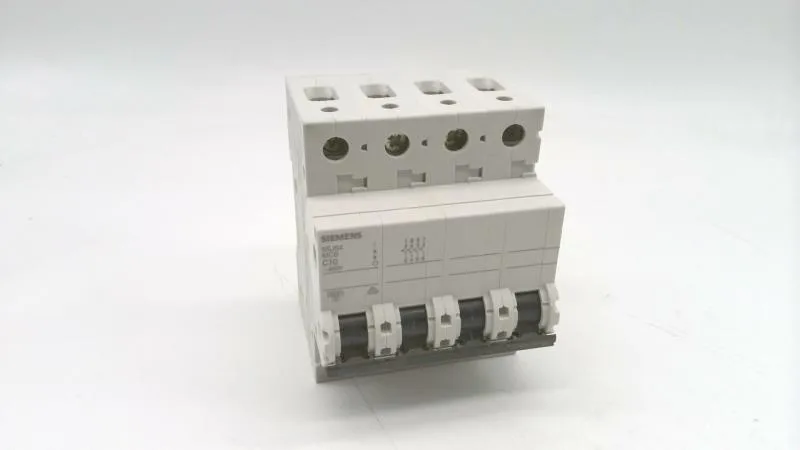
It carries a 6 kA breaking capacity per both EN 60898 and IEC 60947-2 at 400 V AC, which means it can safely interrupt fault currents up to that level on a 400 V three-phase supply — standard for lighting, distribution, and motor branch circuits in commercial and light industrial panels.
The 4 A C-curve is the key selection parameter: C-curve trips between 5 and 10 times rated current (20–40 A magnetic trip), making it suitable for moderate inrush loads like small motor starters, contactor coils, and lighting banks — not for high-inrush transformers or pure resistive loads (those would take B or D curves respectively). The 440 V rated insulation voltage and overvoltage category 3 confirm it's rated for fixed-installation distribution boards, not final sub-circuits with lower fault levels. Wire range is 0.75 to 25 mm² solid or stranded, which covers everything from 1.5 mm² lighting circuits up to 6 mm² feeder tails. Ambient temperature range is -20 to +45 °C, with periodic excursions to +55 °C at 95% humidity. That's the thermal derating boundary: at sustained +45 °C the breaker still carries its full 4 A without nuisance tripping; above that, apply the manufacturer's derating curve.
Deployment context
Snap-on mounting to DIN rail (any position,), occupying 4 width units at 17.5 mm each — 70 mm of panel width. The 4-pole configuration covers three-phase plus neutral switching, which is typical for three-phase distribution boards in commercial buildings, small industrial control panels, and HVAC equipment.