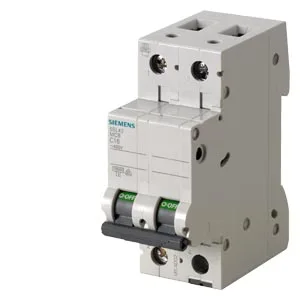
The 5SL4215-7CC: The C-curve (tripping characteristic class C) means the breaker trips at 5 to 10 times rated current — suited for circuits with moderate inrush, such as small motor loads, lighting banks, or transformer primaries in residential and infrastructure panels. The 10 kA breaking capacity at 400 V AC per EN 60898 tells you it can safely interrupt a fault current up to that level without welding contacts or cascading failure upstream. For a 1.6 A rated branch, this is ample headroom for most distribution boards. The 2-pole design switches both phase conductors simultaneously, which is standard for single-phase 230 V circuits in split-phase or line-to-neutral configurations, or for two-phase loads up to 400 V line-to-line. The operating voltage range extends to 440 V AC maximum for multi-phase operation, and the breaker accepts 50/60 Hz supply frequency. Power dissipation is 1.3 W per pole in hot operating state at rated current — relevant for thermal coordination inside a crowded enclosure. The IP20 rating (with connected conductors) means it is protected against solid objects larger than 12.5 mm but not against moisture; install inside a panel or distribution board with a higher-rated enclosure.
Any mounting position is permitted. The breaker is sealable for anti-tamper applications.