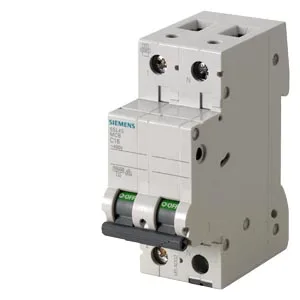
What this MCB is and where it lands
The Siemens 5SL4540-7 is a SENTRON miniature circuit breaker (MCB) with a 1-pole-plus-neutral (1P+N) design, rated 40 A at 230 V AC with a C-curve tripping characteristic. It breaks fault currents up to 10 kA per IEC 60898 and IEC 60947-2, which covers most residential and light commercial distribution boards. The C-curve (5–10× In) means it handles moderate inrush from small motors or transformers without nuisance tripping, while still clearing a hard short fast enough to protect the downstream cable.
Temperature derating — the real current rating changes with the panel environment
At 30 °C ambient the breaker carries its full 40 A. At 40 °C that drops to 36.96 A; at 45 °C it's 35.2 A; at 55 °C it's 31.85 A. If this breaker sits in a warm enclosure — say, above a transformer or next to other densely packed MCBs — the 40 A nameplate is not the working limit. The panel designer should size the load to the derated value at the expected internal temperature, not the 30 °C reference.
Physical fit and mounting
The 5SL4540-7 occupies 2 modular width units (36 mm) on a DIN rail, with a depth of 76 mm and an installation depth of 70 mm. It can be mounted in any position — no orientation restrictions. The housing is IP20 with connected conductors, so it's intended for enclosed distribution boards, not wet or dusty environments. It is sealable (e.g., with lead seals or adhesive labels) for tamper-evident installations. The breaker accepts supplementary devices (auxiliary contacts, shunt trips, alarm switches) on the side, which is useful when you need remote status or emergency shutdown on a specific circuit.
DC rating and single-phase use
While primarily an AC breaker (230 V rated, 50/60 Hz), the 5SL4540-7 carries a DC rating up to 72 V maximum. That covers DC auxiliary circuits in a panel or small PV string combiner boxes, but the DC breaking capacity is not stated — the 10 kA figure applies to AC only. For single-phase AC operation the voltage limit rises to 250 V. The breaker is halogen-free and silicon-free, which matters for installations with strict material compliance requirements (e.g., rail, marine, or semiconductor fabs).
