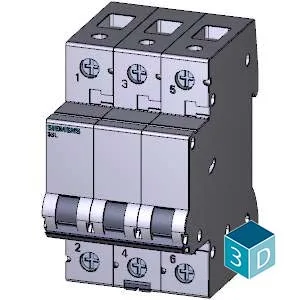
What this MCB is and what the ratings mean for your panel
The Siemens Betagard 5SL7320-8RC is a 3-pole miniature circuit breaker with a D tripping characteristic, rated 20 A at 415 V AC and a 15 kA breaking capacity per both EN 60898 and IEC 60947-2. The D-curve means it tolerates the high inrush currents typical of motor loads, transformers, and welding equipment — the magnetic trip threshold is 10–20× rated current, so nuisance tripping on startup is unlikely. The 15 kA SCCR at 415 V tells you this breaker can safely interrupt a fault up to that level without upstream damage; it's sized for industrial distribution panels where fault currents are substantial. The 3-pole design (3 modular width units, 18 mm per pole) handles three-phase circuits; there is no integrated neutral pole switching.
Derating and ambient temperature — the real current you can carry
The 20 A rating holds at 30 °C ambient. At 40 °C it derates to 19 A, at 45 °C to 18.6 A, at 50 °C to 18 A, at 55 °C to 17.6 A, and at 60 °C to 17.2 A. If your panel runs warm — common in a crowded enclosure — size the upstream protection for the derated value, not the nameplate. The operating temperature range is -40 °C to 75 °C, which covers outdoor cabinets in cold climates and hot machine compartments.
Mounting and integration into the panel
Snaps onto standard DIN rail; mounting position is unrestricted. Overall dimensions are 18 mm wide, 90 mm high, 76 mm deep, with an installation depth of 70 mm behind the panel face. The IP20 rating applies with connected conductors — standard for enclosed distribution boards. Pollution degree 2 and overvoltage category III are typical for fixed-installation industrial and commercial power circuits. Touch protection is built in. The breaker is sealable, halogen-free, and silicon-free, which matters for environments sensitive to outgassing (clean rooms, food processing, medical device manufacturing).