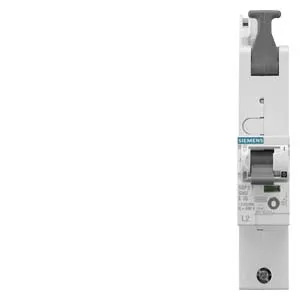
The Siemens 5SP3740-2KK02 is a 1-pole miniature circuit breaker from the SENTRON 5SP3 series, rated 40 A with an E tripping characteristic and a 25 kA breaking capacity per EN 60898. It mounts on a 40-mm busbar system per DIN 43870 Part 2 and occupies 1.5 width units — a form factor designed for residential and infrastructure meter panels where the supply cord enters at the lower section of the enclosure. The E-curve trips magnetically between 10× and 20× In (400–800 A for this 40 A unit), which is higher than a B- or C-curve. That selectivity matters when you have inrush from multiple downstream loads or transformer-fed circuits — you want the branch MCB to clear a fault before the upstream device, not nuisance-trip on a motor start.
The outgoing feeder uses a spring-loaded terminal; infeed is at the box terminal. That 50 mm² top end means it can handle the incoming service cable for a residential main breaker role, not just branch circuits. Protection class is IP40 with connected conductors — fine for enclosed meter panels, not for wet or outdoor locations without a weatherproof enclosure. Mechanical robustness: shock resistance is 30 g for at least 3 impacts at 11 ms duration; vibration resistance per IEC 60068-2-6 is 2 g over 20 frequency cycles from 5 to 150 Hz. The switch position indicator shows green for OFF, red for ON.
Sealing and locking provisions
The 5SP3740-2KK02 is sealable and includes a locking slide compatible with a lock, additional wire seal, cable ties, and Antilux. This is a practical detail for utility metering or tamper-evident installations where the breaker position must be locked after commissioning.