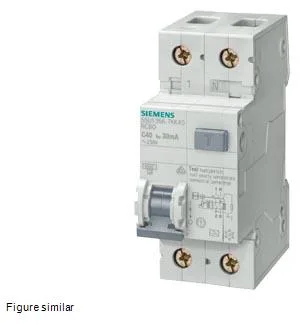
It protects a single-phase final subcircuit against earth leakage and overload/short-circuit in one unit, saving a DIN-rail slot over separate RCD and MCB. The C-curve tripping characteristic means it holds up to 5–10× rated current momentarily, so it's sized for motor or lighting loads with moderate inrush; a B-curve would trip faster on those starts. Rated 32 A at 30 °C, it derates to 24.64 A at 70 °C — the 30 °C figure is the one to use for most panel environments unless the enclosure runs hot.
The 6 kA rating is the minimum for residential/commercial panels. For selectivity coordination upstream, the energy limitation class 3 means it lets through less let-through energy (I²t) than class 1 or 2, which helps the upstream breaker stay selective and not trip on a downstream fault.
Depth is 77 mm, installation depth 70 mm — the extra 7 mm is the front projection of the toggle and test button. Supply can come from either top or bottom, which simplifies busbar routing in a crowded enclosure. The IP20 rating applies only when the distribution board is installed and conductors are connected — bare terminals are finger-safe but not splash-proof.